Water Softeners
Can You Drink Softened Water? The Sodium Question Answered
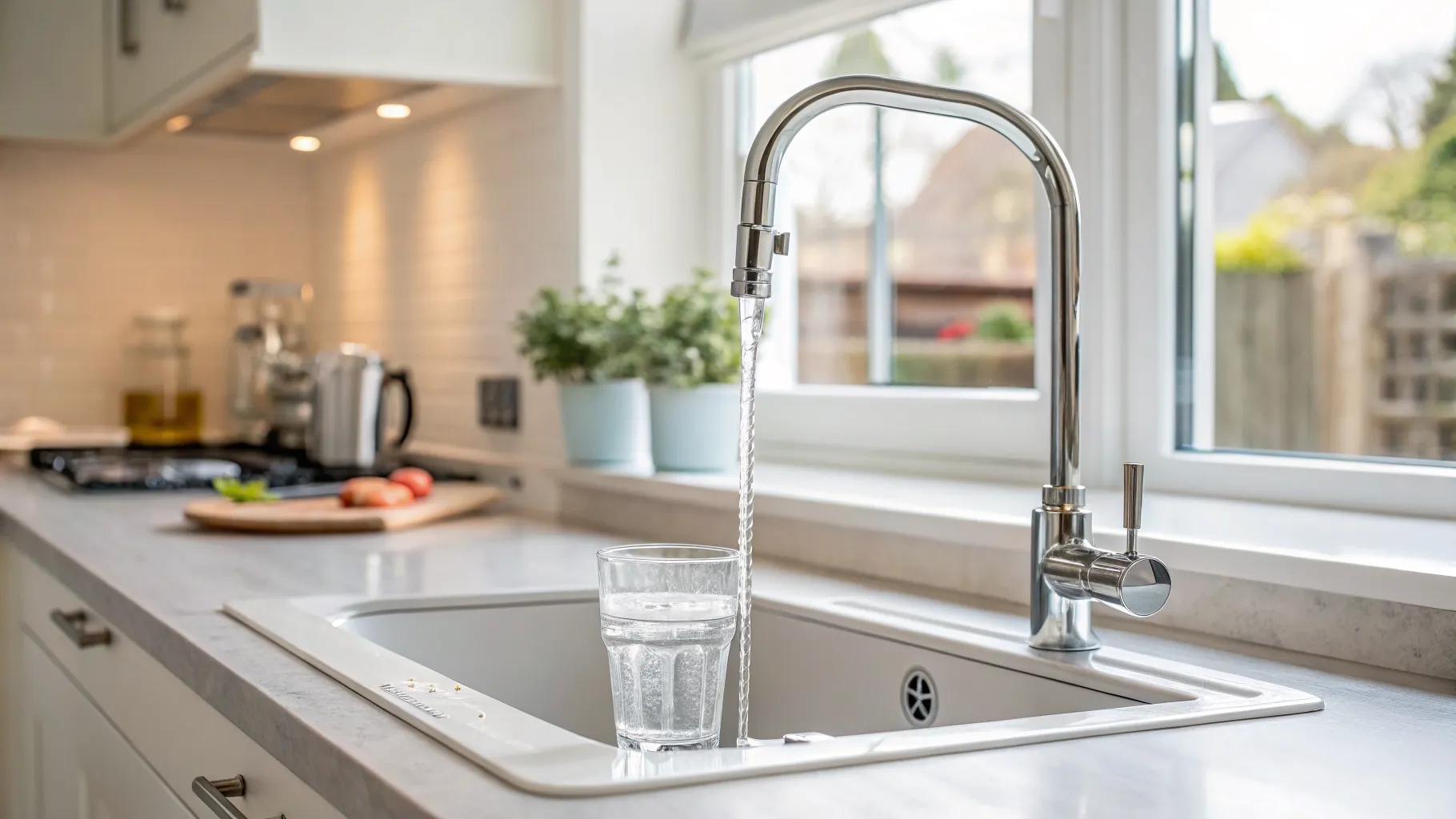
For most healthy adults in most of the UK, yes, you can drink softened water. The two firm exceptions are babies’ formula feeds and anyone on a medically prescribed low-sodium diet. The reason is sodium: a salt-based softener swaps the calcium and magnesium that cause limescale for sodium, and in very hard areas that added sodium starts to matter.
This page sets out the actual numbers, what the law says (and what it does not say), who should stick to an unsoftened tap, and the verbatim NHS and Drinking Water Inspectorate advice that softener vendors tend to paraphrase loosely.
What a softener actually puts in your water
A salt-based softener works by ion exchange. As the Drinking Water Inspectorate (DWI) puts it: “Softeners involve an ion exchange process that replaces calcium and magnesium (hardness) with sodium.” The salt you pour into the cabinet regenerates the resin; it is not tipped into your water. (If you are new to softeners, hard water vs soft water covers the basics.)
The chemistry is predictable: two sodium ions replace each calcium ion, which works out at roughly 46 mg of sodium added for every 100 mg/l of calcium carbonate hardness removed. That single ratio lets you estimate the sodium in your own softened water from your local hardness figure, which your water company publishes (here is how to check yours).
UK hardness is often quoted in Clark degrees. One Clark degree is 14.3 mg/l of calcium carbonate, so each Clark degree softened adds about 6.6 mg/l of sodium.
The sodium maths for your postcode
| Your hardness (mg/l CaCO3) | Roughly in Clark degrees | Sodium added by softening |
|---|---|---|
| 100 mg/l | 7 Clark | ~46 mg/l |
| 200 mg/l | 14 Clark | ~92 mg/l |
| 300 mg/l | 21 Clark | ~138 mg/l |
| 400 mg/l | 28 Clark | ~184 mg/l |
| ~435 mg/l | ~30 Clark | ~200 mg/l (the legal limit, from softening alone) |
The legal context: the Water Supply (Water Quality) Regulations 2016, Schedule 1, set a sodium limit of 200 mg/l at consumers’ taps. Softening alone would only push you past that at around 435 mg/l of hardness, and since the mains supply already contains some sodium, the industry rule of thumb is that softened water stays within the limit where hardness is below about 400 ppm CaCO3. Almost no UK mains supply is that hard; London, one of the harder regions, typically sits in the 250 to 350 ppm range depending on zone.
To put the numbers in food terms: in a very hard area, a full litre of softened water carries roughly 92 mg of added sodium. A typical slice of bread contains more sodium than that. Against the adult NHS guideline of no more than 6 g of salt a day (about 2.4 g of sodium, using the standard salt-to-sodium conversion), softened water is a small contributor for a healthy adult. For babies and people on restricted-sodium diets the calculation is different, as below.
One taste point worth clearing up: softened water does not taste salty. The softener adds sodium ions, not sodium chloride, and at the levels above it sits below the taste threshold in most areas.
What the NHS and DWI actually say
The two exceptions are not Tern Water’s opinion; they are official advice, and they are worth quoting exactly because most softener marketing rounds them off.
Babies’ formula. The NHS guidance on making up baby formula says: “Do not use artificially softened water or water that has been boiled before.” The same page advises against bottled water for formula in most cases, because it is not sterile and may contain too much sodium or sulphate. The background is that babies’ kidneys are not fully developed and cannot process much salt; the NHS limit for under-1s is less than 1 g of salt a day from all sources.
Everyone else. The DWI’s page on domestic water filters and softeners notes that “some water softeners can add significantly to the sodium content of drinking water” and that “it is advised that consumers retain an unsoftened water supply to the kitchen tap for drinking and cooking purposes.” It also repeats the NHS point that artificially softened water should not be used to make up baby feeds.
The DWI raises a less-discussed point too: very soft water, below about 100 mg/l CaCO3, can be corrosive to plumbing metals such as lead, copper, brass and nickel. In an older property with lead pipework or older brass fittings, that is a second, separate reason to keep an unsoftened drinking line rather than softening every tap in the house.
Is a separate hard-water tap a legal requirement?
This is where trade sources blur two different things, so here is the clean version.
What the law requires: under the Water Supply (Water Fittings) Regulations 1999, Schedule 2 paragraphs 26 and 27, premises supplied with water for domestic purposes must have at least one conveniently situated drinking water tap, fed from a supply that delivers wholesome water. Softened water used for drinking, cooking, bathing or washing must remain wholesome, and in practice “wholesome” includes staying under the 200 mg/l sodium limit. (Water Regs UK files its drinking-water-tap guidance under paragraph 27, which is why installers quote both numbers.)
What the law does not say: there is no statute that bans drinking softened water or that forces you to fit a hard-water bypass tap. The dedicated unsoftened kitchen tap is industry code of practice plus DWI advice. It is good advice, especially with a baby in the house or hardness near the top of the UK range, but it is advice, not building regulations.
So a competent installer will normally tee off a small chrome drinking tap from the mains before the softener as standard. The parts are cheap, typically a £20 to £60 item, and the tap is often included in the quoted install price anyway. If you are costing up a system, the tap is a rounding error next to the softener itself: see our running cost breakdown and softener test results.
Who should not drink softened water
- Babies, for formula feeds. The NHS instruction above is unambiguous. Use the unsoftened tap, every feed, no exceptions.
- Anyone on a medically prescribed low-sodium diet. Heart failure, some blood pressure and kidney conditions. If a clinician has restricted your sodium, every avoidable source counts; drink from the unsoftened tap and raise it with your GP if unsure.
- Aquarium fish and ponds. Softened water upsets the mineral balance fish are adapted to. Fill tanks and top up ponds from the unsoftened supply.
Pets are generally fine on softened water; Kinetico, among others, publishes guidance to that effect, though a dog on a vet-prescribed low-sodium diet is the same special case as a human on one. Plants are a grey area: softener vendors themselves advise against using softened water on them, so use the outside tap (which installers normally leave unsoftened anyway).
And one persistent myth: boiling does not remove sodium. Boiling hard water precipitates some limescale out; sodium stays dissolved no matter how long the kettle runs. Tea, coffee and general cooking with softened water are fine for healthy adults, and many people find tea made with softened water tastes better because there is no scum or scale.
If you want softened pipes but unsoftened drinking water
Three practical setups, in rising order of cost:
- The standard separate drinking tap. A small tap on the sink fed from the mains before the softener. Cheapest, simplest, and what the DWI advice effectively describes. Ask for it in any softener install quote.
- An under-sink reverse osmosis system. Strips sodium (and most other dissolved solids) from the softened supply and feeds a dedicated tap. Osmio sells both no-install countertop units (the Osmio Zero) and plumbed systems (the Osmio Fusion, which connects to the cold supply and drain), and BWT offers home RO with remineralisation and a dedicated tap. Budget somewhere in the £150 to £450 bracket for an under-sink system, with countertop units in similar territory. Our RO vs jug vs under-sink comparison weighs these against cheaper filters.
- Both. Plenty of households in very hard areas run a softener for the pipes, appliances and bathrooms, plus RO at the kitchen sink for drinking water. Belt and braces, and still cheaper over a decade than replacing scaled-up boilers.
The short version: drink it if you are a healthy adult, keep one unsoftened tap regardless, and never use softened water for a baby’s bottle.
Frequently asked questions
Is softened water safe to drink? For healthy adults in nearly all UK areas, yes. Softening adds roughly 46 mg of sodium per 100 mg/l of hardness removed, which keeps water well under the 200 mg/l legal sodium limit anywhere with hardness below about 400 ppm, and almost no UK supply is that hard. The exceptions are baby formula and prescribed low-sodium diets.
Can I use softened water for baby formula? No. The NHS says plainly: “Do not use artificially softened water or water that has been boiled before.” Babies’ kidneys cannot process much salt. Use the unsoftened drinking tap for every feed.
Does softened water taste salty? No. Ion exchange adds sodium, not table salt (sodium chloride), and the amounts involved sit below the taste threshold in most areas. If your water tastes salty, something else is wrong; get the softener checked.
Do I legally have to have a separate hard-water tap? Not exactly. The Water Fittings Regulations 1999 (Schedule 2, paragraph 27) require a drinking water tap and require softened water to remain wholesome, but the dedicated unsoftened kitchen tap is industry code of practice and DWI advice rather than statute. Fit one anyway; it costs little and removes the question entirely.
Does boiling softened water remove the sodium? No. Boiling can drop limescale out of hard water, but sodium stays dissolved. The only practical ways to get sodium back out are an unsoftened bypass tap or reverse osmosis.
Can my dog or cat drink softened water? Generally yes; pets handle the sodium levels involved fine unless a vet has put them on a low-sodium diet. Fish are the exception: fill aquariums and ponds from the unsoftened supply, because softened water upsets the mineral balance they need.