Water Softeners
Best Salt-Free Water Conditioners UK: Do They Actually Work?
Search for a salt-free water conditioner and you will find dozens of products promising soft water with no salt, no plumbing and no maintenance. Most of those promises are wrong, and not because the products are scams, but because “salt-free water conditioner” is an umbrella term covering three different technologies with three very different levels of supporting evidence. Lumping them together and giving one verdict is the single most common mistake in the buying guides currently ranking for this term.
Here is the honest split this page is built around. None of these devices soften water in the technical sense. They do not remove the calcium and magnesium that make water hard, so the hardness reading in mg/l of calcium carbonate is identical before and after treatment. What they aim to do is stop scale sticking. That means your real question, “do they work?”, is actually two questions: do they reduce scale building up in pipes and appliances (sometimes, depending on the technology and your setup), and will they give you soft water that lathers and feels different (no, never).
The three technologies hiding under “salt-free”
| Technology | How it works | Evidence level | Typical UK cost |
|---|---|---|---|
| TAC media (Template Assisted Crystallisation) | Plumbed-in media converts dissolved hardness into microscopic crystals that stay suspended | Strongest: independent lab evidence | Premium, several hundred pounds plus fitting |
| Electronic / electromagnetic descaler | Coils wrapped around the rising main send a pulsing field to keep minerals in suspension | Weak and contested | Sub-£100 class |
| Magnetic clip-on | Permanent magnets clamp onto the pipe | Weakest: repeatedly failed controlled tests | Lowest, low double digits |
If you take nothing else from this page, take the order of that evidence column. TAC has credible independent testing behind it. Electronic descalers have mixed real-world results. Clip-on magnets have a long history of failing controlled trials.
What the evidence actually says
TAC media: the one category with real backing
Template Assisted Crystallisation is the only salt-free approach with credible independent lab data. The most cited study comes from Arizona State University (Peter Fox and colleagues, 2011), which found the TAC device was the most efficient at reducing scale, with greater than 88% scale reduction. Independent vendors testing against German protocols quote figures in the 90% region.
The standard worth knowing is DVGW W512, the German Gas and Water Association test protocol for non-ion-exchange scale-control devices. Its pass mark is 80% scale reduction, which is stricter than the 50% threshold used in some US testing. If a salt-free device is genuinely effective, this is the bar it should be able to clear, so it is worth asking a manufacturer whether their unit has been tested to W512 rather than accepting a vague “reduces limescale” claim.
The honest caveat applies even here: TAC does not change a hardness titration. The minerals are still in the water. It changes whether they stick, not whether they are present.
In the UK, the higher-end inline conditioners sit in this category. The Halcyan whole-house range is a UK example, WRAS-certified to UK drinking-water standards, sold as a premium plumbed-in unit rather than an Amazon impulse buy. It is a useful reference point for what a credible, tested salt-free unit looks like, and for what that level of performance costs.
Electronic and electromagnetic descalers: genuinely mixed
These are the coil-wrap units. A microchip generates a changing field through coils you wind around the incoming pipe, and the manufacturer’s explanation is that this keeps minerals in suspension so they are flushed through rather than depositing as scale. The effect is described as lasting around 48 hours, so the treated water needs to be used reasonably soon.
The Chartered Institution of Building Services Engineers (CIBSE) describes electromagnetic devices as “much stronger” than simple magnets, but the real-world UK picture is genuinely split. There are long-term users who report their kettle and showerhead scale up far more slowly, and there are users, especially in very hard water, who saw no difference at all. The honest framing is that any benefit tends to be subtle and gradual, it will not remove scale you already have, and it will not make the water feel soft.
The Eddy Electronic Water Descaler is the best-known British-built example. It is a twin-coil unit that wraps around the rising main, runs off the mains, and fits without any plumbing, which is the main appeal. The manufacturer keeps the minerals in suspension for roughly 48 hours and backs it with a 12-month money-back guarantee and a lifetime warranty against breakdown. Treat it as a scale-reduction aid for kettles, showers and pipework rather than a softener, and set expectations accordingly if you are in a very hard water area.
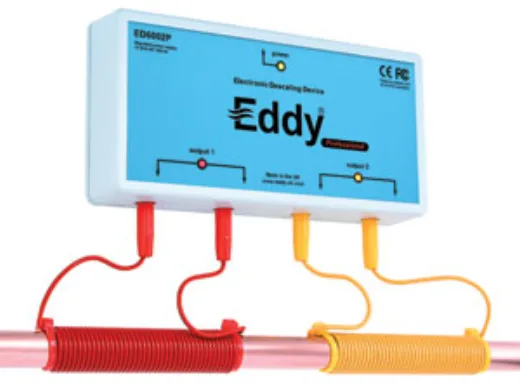
You can read the manufacturer’s own description on the official Eddy water descaler site.
Magnetic clip-on conditioners: be most sceptical
These are the cheap permanent magnets that clamp onto the pipe. They are also the least supported. The US Army Corps of Engineers research centre (ERDC) field-tested magnetic descalers and found no clear benefit, and earlier work by Duffy at Clemson University (1977) concluded magnetic treatment had no significant effect on scale on pipes or appliances. CIBSE itself notes that with simple magnetic devices “the effect is short lived”.
There are inline products that combine a 15mm compression scale inhibitor with magnetic conditioning, such as the PlumbEZ WRAS scale inhibitor, sold as boiler protection. If you buy one, treat it as low-cost scale mitigation, not as softening, and judge the magnetic element against the evidence above. Check the current price on Amazon before deciding.
The limitation almost nobody mentions: stored water
This is the single most important practical point, and most ranking pages skip it. CIBSE is explicit that conditioning via these physical methods is temporary and “will be lost if the water is stored”. The guidance is that physical conditioners work best on continuous-flow systems and lose their effect where water sits for extended periods.
In plain terms: a salt-free conditioner has its best chance on pipework and continuous-flow appliances, and its worst chance on a hot-water cylinder where treated water sits for hours. If your home has a stored hot-water tank rather than a combi boiler, factor this in heavily.
One more honest expectation from the same CIBSE source: the scale is suspended, not removed, so you will still see limescale where water evaporates. Showerheads, glass screens, taps and stainless steel sinks will still spot where droplets dry.
CIBSE also gives a useful temperature fact: calcium carbonate practically starts precipitating at around 35 to 40 degrees C, which is why scale forms in your kettle, boiler and shower rather than your cold tap. You can read the full module on the CIBSE Journal CPD pages.
Do you even need one? The UK hardness picture
Over 60% of UK homes are supplied with hard or very hard water, concentrated across the south and east of England. London sits at roughly 280 to 320 ppm, very hard, drawn from chalk aquifers. The south-east, East Anglia, Lincolnshire and the Hull arc are the hardest. Scotland, Wales, the South West and the North West are mostly soft, fed by upland catchments and igneous rock. If you are in a soft-water area, you do not need any of this; check first with our guide to whether your water is hard or soft.
The Drinking Water Inspectorate (DWI), the statutory drinking-water regulator for England and Wales, publishes the authoritative hardness bands in mg/l of calcium carbonate:
| Classification | mg/l CaCO3 |
|---|---|
| Soft | up to 100 |
| Slightly hard | 100 to 150 |
| Moderately hard | 150 to 200 |
| Hard | 200 to 300 |
| Very hard | more than 300 |
CIBSE notes that softening or conditioning is normally considered once total hardness approaches and exceeds 200 mg/l, which maps onto the DWI “hard” band.
The genuine case FOR going salt-free
The scepticism above is not the whole story. Staying salt-free has real, defensible advantages, and these are where the category earns its place.
There is no added sodium in your drinking water. The DWI advises against softening the kitchen drinking tap because the sodium in salt-softened water can be a problem for premature babies and for anyone on a low-sodium diet. A conditioner leaves the water chemistry alone, so the drinking tap is unchanged. It also retains the calcium and magnesium that a salt softener strips out.
Beyond that, the practical wins are real: no salt to buy and lug, no regeneration cycle, no wastewater, no drain connection needed, and for the electronic and magnetic types, no plumbing at all. For the right home, in the lower hardness bands and on continuous-flow systems, that simplicity is the point.
Salt-free conditioner versus salt-based softener
This is the decision most readers actually need to make.
| Salt-free conditioner | Salt-based ion-exchange softener | |
|---|---|---|
| Removes hardness minerals | No | Yes |
| Water feels “soft” (lather, skin) | No | Yes |
| Adds sodium to water | No | Yes |
| Reduces scale | Sometimes, depends on type and setup | Yes, proven |
| Needs salt and maintenance | No | Yes, ongoing |
| Needs plumbing and a drain | TAC yes, electronic/magnetic no | Yes |
If you want guaranteed soft water that lathers and stops scale dead, a salt-based ion-exchange softener is the only proven route, with the trade-offs of cost, salt, maintenance and the DWI drinking-tap advice. If you want to avoid salt and sodium, keep the job simple, and you accept scale reduction rather than removal, a salt-free conditioner can suit you, ideally TAC if budget allows. Our deeper comparisons cover both routes: see water softeners versus scale reducers, the best water softener UK guide, and the honest running costs of a softener.
Frequently asked questions
Do salt-free water conditioners actually work? It depends entirely on the technology. TAC media has independent evidence behind it, with greater than 88% scale reduction in the most cited study and an 80% pass mark in the DVGW W512 standard. Electronic descalers give mixed, gradual results in the real world. Clip-on magnets have repeatedly failed controlled tests. None of them produce soft water; they reduce scale sticking rather than remove minerals.
Do they remove existing limescale or only prevent new scale? Mostly they prevent new scale. Some TAC media is claimed to reduce existing buildup gradually, but electronic and magnetic conditioners generally do not remove scale you already have. If you have heavy existing limescale, you will still need to descale manually first.
Will my water actually feel soft? No. Because these devices do not remove the calcium and magnesium, you will not get the classic soft-water feel of easier lather and softer laundry. That requires a salt-based ion-exchange softener.
Is salt-free conditioned water safe to drink? Yes. No sodium is added and the minerals stay in, which the DWI treats as an advantage over salt-softened water for premature babies and anyone on a low-sodium diet.
Will a conditioner protect my boiler, kettle and shower? Best case is pipework and continuous-flow appliances like a combi boiler, kettle and shower. Worst case is a stored hot-water cylinder, where CIBSE says the conditioning effect is lost once water is stored.
Do they work in very hard water areas like London? Effectiveness tends to drop as hardness rises, so in very hard water above 300 mg/l you should manage your expectations and lean towards a tested TAC unit or a salt-based softener if results matter.
Do they need power, plumbing or maintenance? Magnetic clip-ons need none of those. Electronic descalers like the Eddy need mains power and a DIY coil wrap but no plumbing. Inline TAC units are plumbed in, and the media typically lasts several years before replacement.
Are they WRAS approved? Some plumbed-in units are, including UK TAC conditioners. WRAS approval is a useful credibility marker for any device that connects into your mains supply, so it is worth checking for on inline products.
This page contains affiliate links. We only feature products with a verified UK listing, and we do not quote prices, since they change; check the current price on Amazon before buying.